 Crumb Club
Quick answer: Cookies spread too much when the dough is too soft or too warm to hold its shape before the oven sets it. The most common causes are butter that's too warm, too little flour, a warm or greased baking sheet, and an oven that isn't fully hot. Chilling the dough for 30–60 minutes and weighing your flour fix most cases.
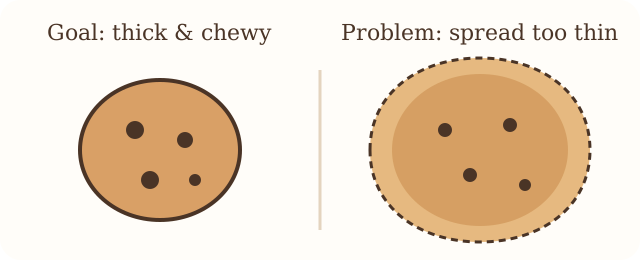
Why cookies spread at all
As cookie dough heats up, the butter melts and the dough relaxes and starts to flow. At the same time, the heat sets the eggs and flour, which "locks" the cookie's shape. A good cookie happens when the shape sets before the dough flows too far. Every cause below either makes the dough flow sooner or delays the moment it sets.
1. Your butter is too warm
"Room temperature" or "softened" butter in a recipe does not mean soft and shiny. If your butter is greasy, melting at the edges, or was softened in the microwave, the dough starts out too warm and spreads as soon as it hits the oven.
The fix: Properly softened butter is still cool to the touch and leaves a dent when you press it, with some resistance. Leaving it on the counter for about 30–45 minutes usually works, depending on how warm your kitchen is. If it gets too soft, put it back in the fridge for 10 minutes.
2. You're using too little flour
Flour is the main structure in a cookie. Measuring cups are surprisingly inaccurate. A cup can hold noticeably more or less flour depending on how you fill it, and recipes are written for a specific amount.
The fix: Weigh your flour. King Arthur Baking lists one cup of all-purpose flour as 120 grams. If you don't have a scale, fluff the flour, spoon it into the cup, and level it with a knife. Don't pack it or scoop straight from the bag.
3. There's too much sugar or liquid
Sugar melts in the oven and turns into liquid, so extra sugar means extra spread. Extra liquid works the same way. A common hidden source is egg size: recipes assume large eggs, about 50 grams each without the shell. Extra-large or jumbo eggs add extra liquid.
The fix: Use large eggs and measure sugar carefully. If a recipe always spreads for you, King Arthur Baking suggests reducing the sugar by about 10% (by weight) as a test.
4. Your baking sheet is warm or greased
Putting dough on a sheet that's still warm from the last batch starts melting the butter before the cookies reach the oven. Greasing the pan gives the dough a slippery surface to slide across. In a King Arthur Baking test of pan liners, greased sheets gave burnt, lacy edges and foil caused the most spread, while a silicone baking mat produced the thickest, most even cookies.
The fix: Use a silicone mat or parchment paper instead of grease (unless the recipe says otherwise). Let pans cool completely between batches, or switch between two sheets.
5. Your oven isn't as hot as it says
Many ovens beep "ready" before they've actually reached the set temperature. In a cooler oven, the butter melts before the cookie's structure sets.
The fix: Put an inexpensive oven thermometer in the center of the oven, and wait until it shows the right temperature before baking. If your oven always runs cool, raise the dial to compensate.
6. Your baking soda or baking powder is old
Leaveners lose strength over time. Expired leavening doesn't lift the dough properly, so the cookies bake flatter and denser.
The fix: Test them. Stir a little baking powder into hot water. It should bubble right away. Add a little baking soda to vinegar. It should fizz strongly. If either one barely reacts, replace it.
7. You skipped chilling the dough
Chilling firms up the butter so the dough holds its shape longer in the oven. It's the single most reliable fix for spreading, especially in a warm kitchen.
The fix: Scoop the dough into balls, then chill for 30–60 minutes and bake straight from the fridge. Very soft doughs may need 1–2 hours.
Quick diagnosis table
| What you see | Most likely cause | Try first |
|---|---|---|
| Thin, greasy cookies with crispy, lacy edges | Butter too warm, or greased pan | Chill dough; use parchment |
| Cookies spread into each other | Too little flour, or dough balls too close | Weigh flour; leave 2 inches between balls |
| First batch fine, later batches flat | Warm baking sheet | Cool pans between batches |
| Flat and pale, slow to brown | Oven running cool | Check with oven thermometer |
| Flat, dense and a little bitter or soapy | Old or mismeasured baking soda | Test leavening; measure carefully |
Your pre-bake checklist
Print this out or screenshot it before your next batch:
- Butter is cool and dents when pressed, not shiny or melting
- Flour is weighed (120 g per cup) or spooned and leveled
- Eggs are large, not extra-large
- Dough is chilled for at least 30 minutes
- Baking sheet is cool and lined with parchment or a silicone mat
- Oven thermometer shows the right temperature
- Baking soda or powder passed the fizz test
Want to go deeper? The planned Cookie Fundamentals course expands on this guide with lessons on creaming, chewy vs. crispy texture, and a guided practice bake. Still stuck? Check the beginner baking FAQ.
Sources
- King Arthur Baking, "Why are my cookies spreading?"
- King Arthur Baking, "Cookies spreading? It might be your pan lining."
- King Arthur Baking, Ingredient Weight Chart
- Land O'Lakes, "Cookie Know-How: Why Do My Cookies Spread?"